Welcome
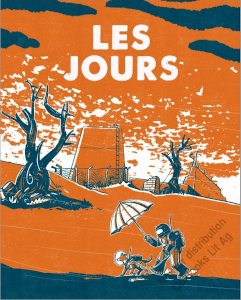




















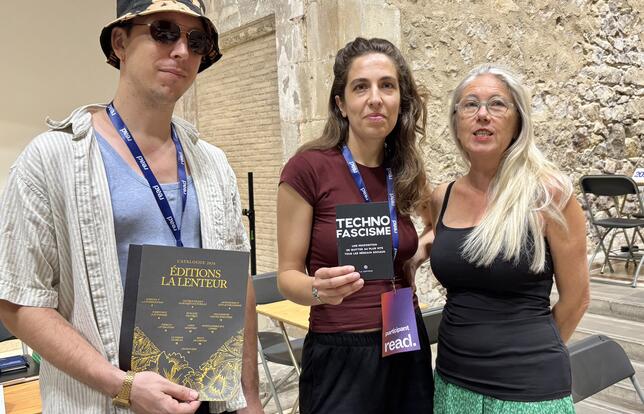
I attended the READ in Barcelona and it was a wonderful moment of dialogue, conversations and business.
I was with the Editions la Lenteur, which recently joined the agency. Fully aligned with READ’s objectives, La Lenteur had also a stand at READ. The titles in their catalogue are quite clear : Technofascisme (sept. 2026), Two Irreconciliable Ecologies.
Governing the living or reinventing life (2026), Against Digital alternatives (2023), Land and Freedom. A quest for autonomy versus the fantasy of liberation (2021), etc. Olivia Snaije, Journalist who is so involved in the world of books, she wrote an article for Livres-Hebdo in France. A lovely team photo is featured in it. Thank you, Olivia!
Complete catalogue
Extract in English of the Catalogue

What is about La lenteur. Let’s let them introduce themselves.
“Éditions de la Lenteur publish texts sharing the conviction that the massive expansion of technology is a fundamental source of pervasive political fatalism. The decades-long development of ever more powerful machines and computers increases labor exploitation and alienation in everyday life. Far from liberating humanity, modern technology binds individuals to the social body in an unprecedented and regressive way.
La Lenteur was born out of the practice of writing texts in support of anti-industrial struggles and perspectives. We mainly circulated the texts outside the bookshop network. In 2004, we participated in writing the brochure “Les États Généraux de la servitude” (“The Estates General of Servitude”), which documented the opposition of radical groups to the research campaign “Sauvons la recherche” (“Let’s Save Research”). This opposition gave rise to Oblomoff, a group that also produced brochures on the subject.
Involved in the movement against advertising and opposed to the installation of biometric systems in schools (and elsewhere), we also took part in the student movement against the Contrat Première Embauche (CPE), a proposed “First Employment Contract”, in spring 2006. We were a small group of friends committed to a radical critique of industrial society, and wherever we went, we encountered the difficulties of sharing this critique. We came up against the inability, and even refusal, of the left (Attac, Le Monde diplomatique, trade unions, political parties, associations) to consider consumerism, technoscience and environmental degradation as major political issues. Our criticism of the digitalisation of public space came up against the demands of militant effectiveness and an undisguised enthusiasm for new technologies and forms of communication. Coming from the left ourselves, at least through our families, friendships and places we used to frequent, we could not help but be struck by the power of this repression, and we were aware that the few spectacular actions, such as those we participated in, would not be sufficient to trigger the necessary debate on the divorce between technological progress and human progress: in an era without any immediate prospect of an emancipatory uprising, it appeared essential to get down to substantive work and contribute to changing the atmosphere.
Since we founded our publishing house, we have never used social media or electronic payment methods, nor have we created a website or worked with Amazon. For reasons of consistency rather than purity, and perhaps simply because we are not interested in them: we don’t know how to use these tools and have no desire to learn. Moreover, we are convinced that the production and circulation of ideas that offer a critique of the industrial system will sooner or later be condemned if they remain dependent on the means that this very system “generously” provides.
In that sense, we are defensive, like all those who share our sensibility, and we have to accept a certain number of contradictions, since books cannot be produced without industrial means. It may be difficult to imagine having a place in the “book chain” without using the Internet at all, but we are determined not to use PayPal, HelloAsso, Instagram or YouTube, in order to avoid contributing, even on a very small scale, to services that, by reinforcing individual isolation, have created a widespread sense of powerlessness, which, among other things, contributes to the rise of the right. Thus, we may lose some readers and sales in the short term, but we know that we have survived until now thanks to book tables set up across France, numerous letters from readers, and dozens of presentations in bookshops.” Translation by Lara Pugh.
“French Rentrée littéraire” : Christian Bourgois editions highlights Gustavo Faverón’s novel Les lieux souterrains, translated into French from Spanish (Candaya).
CONTACT
(for security reasons we always use an email ending by @sosavbooks.com)
Publishers, you can contact us to arrange a virtual meeting and of course we will meet at the major book fairs and exhibitions when I attend.
Article about the agency published by New Spanish Books in french
In Quimera magazine